Red Debt Redemption
Inspiration
Our inspiration came from personal experience navigating student debt—feeling confused, unsure, and overwhelmed by financial decisions we weren't prepared to make. None of us had in-depth financial literacy backgrounds, but we had a strong desire to learn. As we researched the student debt crisis and its history, we realized we weren't alone: financial literacy education is often disengaging, formal, and confusing, leaving many students without the tools they need. We wanted to change that. Our goal was to create a fun, engaging experience that reaches students who can relate to our character's journey and learn to make responsible financial decisions in a low-stakes environment. The student debt experience is universal, and we wanted to empower our peers with the skills and knowledge to improve their financial outcomes. We also challenged ourselves by choosing a completely new game engine and scripting language—learning alongside our players.
What it does
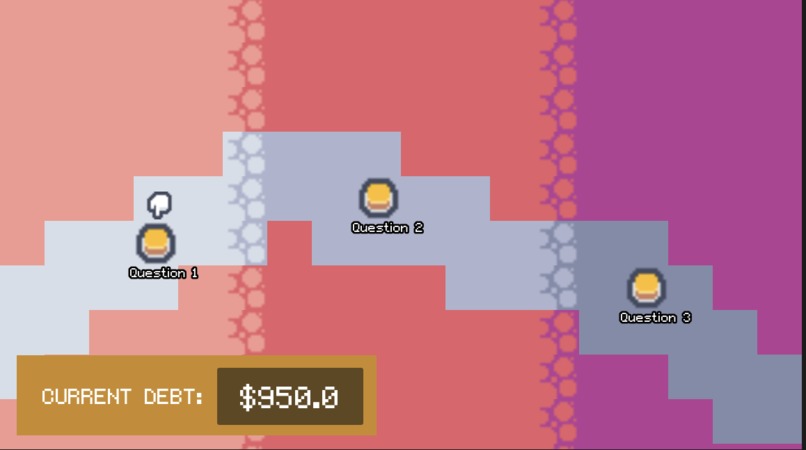
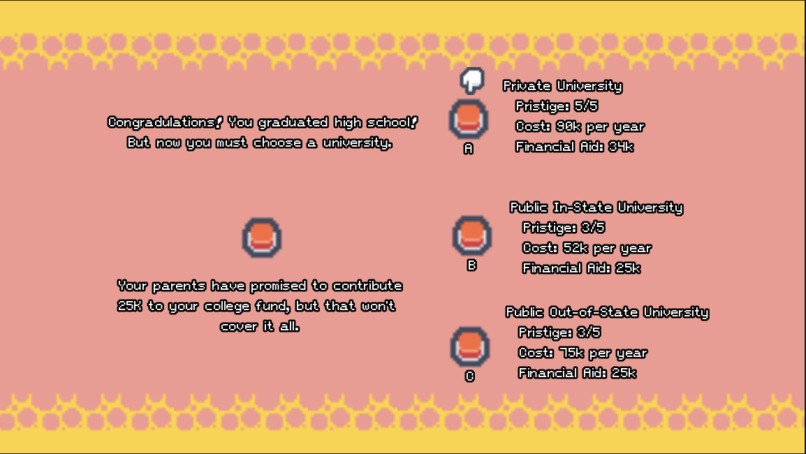
Red Debt Redemption is an interactive narrative game that puts players in the shoes of a recent high school graduate navigating major financial decisions. Players choose which college to attend, whether to work during school, what job to take, and how to handle unexpected expenses—like whether to pay for a doctor after slipping on ice. The core gameplay loop centers around monthly "survival" periods where players blast through bill monsters, grocery monsters, and rent blobs using a fixed monthly budget as ammunition. Any money left over at the end of the month goes directly toward paying down student debt. In the midst of these battles, unexpected expenses arise and players make critical decisions. In between these month periods, players are faced with major financial decisions with consequences. Through this cycle of decision-making and resource management, players learn practical financial literacy skills in an informative and engaging environment. Our target audience is college students who are facing—or will soon face—these decisions in real life. The ultimate goal of the game is to pay off all debt while learning to make responsible financial choices along the way.
How we built it
We built Red Debt Redemption using Godot 4.6 and GDScript, with GitHub for version control and assets from itch.io and the Godot asset library.
Team roles were as follows: Tyler-- Developed the combat/blasting mechanics and enemy systems Rin-- Built level selection menus, scene navigation logic, and interactive decision-making sequences Dylan-- Conducted research on student debt statistics to model narrative design around real-world data, and implemented progress tracking (debt meters, battle components, level transitions)
We started by brain-dumping ideas on paper, then narrowed down our top two ideas through research and feasibility. After committing to financial literacy education through a game, we moved to whiteboard sketches—mapping out gameplay mechanics, UI flows, and narrative. Our build order prioritized: story foundation → gameplay mechanics → UI design.
Challenges we ran into
None of us had used Godot before this hackathon. Learning a new game engine, GDScript syntax, scene management, and signal systems from scratch while under time pressure was intense. We spent hours debugging issues like signals not connecting, scene transitions breaking, and UI elements not updating properly. We also ran into Godot-specific version control conflicts. Coordinating three people working on interconnected game systems through GitHub presented merge conflicts and scene file issues we had to learn to navigate. Building a complete game loop with narrative, combat, and economic systems in a hackathon timeframe meant aggressive scoping and prioritization.
Accomplishments that we're proud of
We're proud of finishing a working demo from scratch that's playable. Starting with zero Godot experience and ending with a functional prototype was a rewarding experience. Technical accomplishments we're proud of are:
- Functional level selection system and gameplay transitions after challenges with learning and debugging scene management.
- Implementing multiple enemy types with different health levels
- The bill-blasting mechanic makes debt management fun and engaging. Shooting down bills, groceries, and rent monsters provides a unique learning experience.
What we learned
- Godot fundamentals: node architecture, signals, scene trees, scene management, autoload patterns
- GDScript programming and debugging
- Rapid prototyping
- Financial literacy insights into key factors that influence financial well-being for undergraduate students, learning about federal student loans
What's next for Red Debt Redemption
We want to implement more UI into the game with a starting menu and pause menu. We would also want to add logic to determine starting debt from the first major decision.
We want to implement pop-up events during combat that force players to make snap financial choices under pressure. Imagine fighting bills when suddenly your car breaks down, a friend invites you to a concert, or you get a minor injury—do you pay for the fix/experience/doctor, or push through and risk consequences? These unexpected expenses mirror real life's financial curveballs.
Additionally, we want to add more narrative branches to our decision tree. We want these branches to cover housing choices, social expenses, insurance decisions, and emergency fund scenarios. We also want to integrate more statistic facts and explanations in the narrative, like post-decision breakdown explanations.
Download

Leave a comment
Log in with itch.io to leave a comment.